A freelance proposal has one job: make the next step obvious. A long list of past work and services does the opposite. It makes the client do the work of figuring out what they should ask you for.
I learned this on a first proposal to a new client. I described my track record and the services I offered in detail, and the response was thin. I sent it again as a single page covering the client's problem, the proposed solution, the timeline and the price. The reply said it was now easy to see what they could ask me for, and that turned into an actual negotiation about the job. Nothing about my experience had changed between the two versions. Only what the page answered had changed. I also describe this experience in a GIGS Magazine Q&A on raising rates.
The four questions the page has to answer
- What is the problem? Write this first, before any mention of yourself, and in the client's terms rather than yours. In an earlier proposal, the line that mattered read something like: the current content has enough depth, but it is likely losing traffic to a mismatch with search intent, and restructuring around intent first is what would recover it. One sentence like that shows you understood the situation before proposing anything.
- What will you do about it? Three or four concrete deliverables, in plain words. Say what the client will have at the end, not how many hours or which tools you will use.
- By when? A start date, the points where the client will see progress, and a delivery date. Vague timelines read as vague commitment.
- For how much? One number, or a clear range, and what it includes. This is also the place to say what it does not include, which is the cheapest protection against the scope drift described in our piece on scope creep and rate increases.
If the page answers those four and ends with a single next step, it is complete.
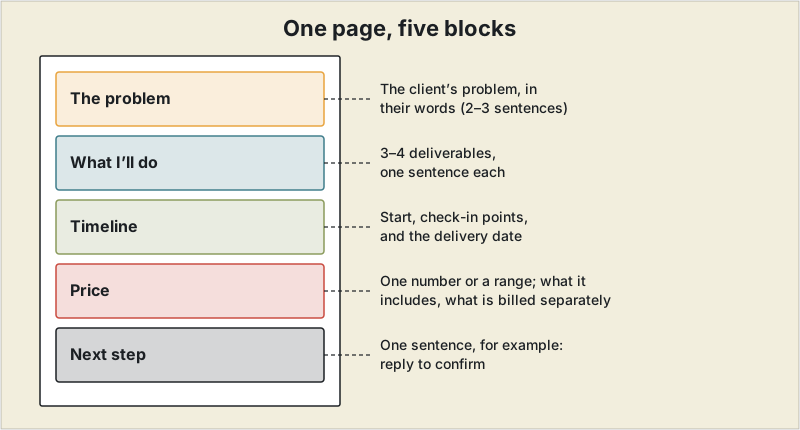
A fill-in skeleton
Proposal for [project name]
The problem. Two or three sentences describing what is not working for the client, in their words.
What I'll do. Three or four deliverables, each one sentence.
Timeline. Start date, check-in points, delivery date.
Price. [One number or range]. Includes: [what the price covers]. Billed separately: [anything outside it].
Next step. One sentence, for example: reply to confirm and I'll send the contract.
What I'd leave off the page
The detailed track record is the part to cut. A single line about relevant experience and one link to your portfolio or a relevant sample is usually enough, because on a short page every sentence about you is a sentence not about their problem. Credentials still matter, but they work best underneath a clear understanding of the job, not instead of it.
When one page is not enough
A larger or multi-phase project needs more than a page, but the same order still helps: problem first, price last, and a clear statement of what is out of scope. At that point the proposal also starts to overlap with the contract, so it is worth running through our client contract checklist before the work begins, and our new-client vetting checklist before you spend time on a proposal at all.
If proposals are going unanswered, see what I would change first.
Do you need proposal software?
Not for a single page. A clean PDF or document works, and a free e-signature tool is enough to make it binding (see our guide to free e-signature tools). Dedicated proposal software earns its cost when you send proposals regularly and want to know when a client opens one, or collect a deposit at signing. Our proposal software comparison covers those options and what they cost.
What I actually put on my one page
I keep my own proposals to a single A4 page so the client can judge it quickly. What I include: my understanding of the request and its background, the problem to solve, what I will do and deliver, how the work will proceed, the schedule, the price, what is in and out of scope, the number of revisions, how long the quote is valid, and the next action I need from the client.
For the price, I give a single amount when the content is reasonably settled. When requirements are still vague I may give a range by scope of work, but a range alone is hard for the client to act on, so I also state the condition: "for this scope, this amount."
Bottom line
Write the page for the client's problem, not for your own résumé: problem, plan, timeline, price, next step. If a longer version is not getting replies, try cutting it down to those four answers before changing anything else.
This reflects one freelancer's experience with specific proposals. What a given client responds to varies, so treat the format as something to test, not a guaranteed result.
Frequently asked questions
How long should a freelance proposal be?
There is no fixed length. For a small or well-defined project, one page that answers four questions (the problem, what you will do, by when, and for how much) is often enough. Larger or multi-phase work needs more, but each added page should answer something the client actually wants to know.
What should a freelance proposal include?
At minimum: the client's problem in their own terms, the specific deliverables, a timeline, a price with what it does and does not include, and one clear next step. For larger projects, add an explicit list of what is out of scope.
Should I include my portfolio and past work in a proposal?
Keep it brief: one line about relevant experience and a link to a relevant sample is usually enough. A detailed list of past work and services tends to make a proposal about you rather than about the client's problem, which is what they are reading for.
Do I need proposal software to send a one-page proposal?
No. A clean PDF or document works, and a free e-signature tool can make it binding. Proposal software becomes worthwhile if you send them regularly and want open tracking or deposit collection at signing.