Short answer: when proposals go unanswered, the usual cause is that they talk about you instead of the client's problem, or that the next step is hard to see. Open with the client's problem, keep it to one page, and end with a single next step. That is what changed the response for me.
Two things that happened
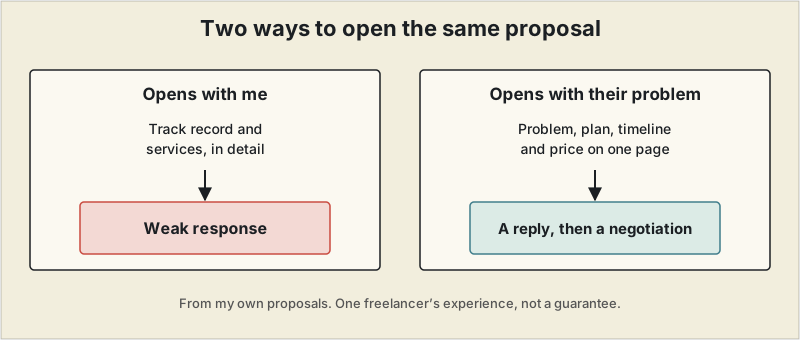
The first was two proposals sent in the same week that landed completely differently. One opened with a list of my past work and skills. It was thorough, entirely self-focused, and went nowhere. The other opened by naming the client's actual problem before proposing anything, something close to "the current content has enough depth, but it is likely losing traffic to a mismatch with search intent." That one line, placed before any mention of my experience, was the only real difference between the two documents, and it is the one that got signed.
The second was a first proposal to a new client. I described my track record and the services I offered in detail, and the response was thin. I sent it again as a single page covering the client's problem, the proposed solution, the timeline and the price. The reply said it was now easy to see what they could ask me for, and it led to an actual negotiation.
What I would change, in this order
- Open with their problem. Put it in the client's own terms, before any mention of yourself.
- Cut it to one page. The problem, what you will do, the timeline and the price. Details of your background can be one line and a link.
- End with one next step. Make replying easy, for example by asking them to confirm so you can send the contract.
The full format, with a template, is in the one-page freelance proposal. If you send proposals often, our proposal software comparison covers tools for tracking and signing.
How long I wait before following up
How long a reply takes varies a lot: the fastest was the next day and the slowest about a week. I used to check my email over and over. Now I treat about five business days as a guide and follow up once if there has been no reply. The message is along these lines (a translation): "I wanted to check how the proposal I sent is going. If there's anything you'd like to clarify or adjust, please let me know." I try not to sound pushy, and to leave the client room to ask a question or to say no.
This is based on two of my own proposals, so treat it as something to test rather than a guaranteed result.
Frequently asked questions
How long should I wait before following up on a proposal?
A few business days is a common starting point, then one short follow-up. Mention the proposal and ask whether anything is unclear rather than whether they have decided.
Should I include my portfolio in a proposal?
Keep it to a single line about relevant experience and one link. On a short page, every sentence about you is a sentence not about the client's problem.
Do I need proposal software?
Not to send a good proposal. A clean PDF or document is enough, and software helps mainly with tracking opens and collecting signatures. Our comparison covers the options.