If a client is paying you from another country and you are choosing between Wise and Payoneer, the short answer is this: Wise is usually cheaper when clients pay you directly, and Payoneer earns its place when your income comes through marketplaces like Upwork or Fiverr. The rest of this page is the reasoning, using one $1,000 payment so the difference is concrete rather than a list of percentages.
The same $1,000, three routes
These are illustrative ranges built from the fee schedules both companies publish, not a quote. Your corridor, currency and account type will move the numbers, so treat them as a way to compare shapes of cost.
| Route for a $1,000 client payment | Rough cost | What drives it |
|---|---|---|
| Wise, client pays by bank transfer | about $3.50–$11.60 | A disclosed fee at the real mid-market rate |
| Payoneer, marketplace payout into a receiving account in your local currency, then a same-currency withdrawal | about $1.50 | Flat withdrawal fee, no conversion |
| Payoneer, USD receiving account, then withdrawal into a bank account in your own currency | up to about $30 | Roughly 1% to receive plus a markup of up to roughly 2% on conversion |
The middle row is the reason Payoneer is popular with marketplace freelancers: when nothing needs converting, it is very cheap. The last row is the reason it gets a reputation for fees: the moment a conversion enters the chain, the cost sits inside the exchange rate rather than on a line item you can see.
Where Payoneer's costs come from
Payoneer's pricing has three layers, and which ones apply depends on the route.
- Receiving. Money from a marketplace or from another Payoneer user is generally free to receive, and so is a receiving account in the local currency of your primary location. A receiving account in a different currency is typically around 1%, and card payments from clients cost noticeably more.
- Conversion. If the currency of the payment is not the currency of your bank account, a markup is applied to the exchange rate. This is the layer most freelancers never notice, because it never appears as a separate charge.
- Withdrawal. Same-currency withdrawals to a bank are usually a small flat fee. Cross-currency withdrawals cost more, and published schedules put them at up to about 2% or higher on some routes.
What you get in exchange is reach. Upwork, Fiverr and many other platforms can pay directly into Payoneer, and a client who has never heard of Wise may already be paying through it.
Where Wise's costs come from, and where it falls short
Wise converts at the real mid-market rate and charges a disclosed fee on top, so the number you are shown before sending is close to what arrives. It also issues local account details in several major currencies, which lets a client pay you like a local recipient instead of sending an international wire.
The limits are practical ones. Wise is not wired into freelance marketplaces the way Payoneer is, so for marketplace income it usually means an extra step. And availability varies by country, so confirm that your country supports the features you need, such as receiving account details in the currency your clients use.
Which one fits which situation
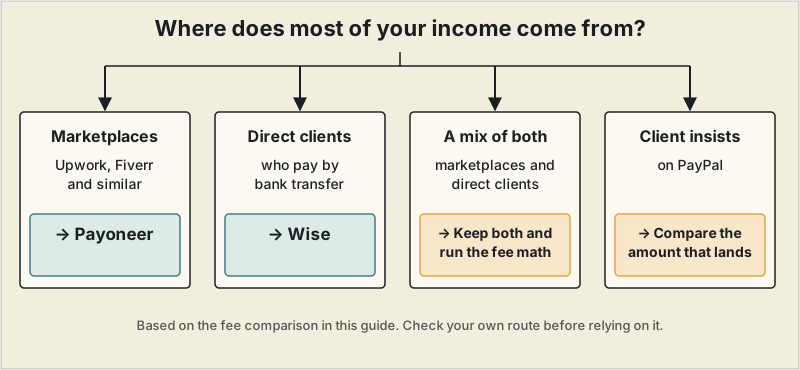
- Most income from Upwork, Fiverr or similar: Payoneer, because the marketplace pays into it directly and a same-currency withdrawal is cheap.
- Mostly direct clients who pay by bank transfer: Wise, because the exchange rate is the biggest cost on most payments and Wise is the one that does not mark it up.
- A mix of both: Many freelancers keep both accounts. Some withdraw marketplace earnings from Payoneer into a Wise account in the same currency and convert there, but only worth doing if the withdrawal fee plus Wise's conversion fee comes out below Payoneer's own conversion markup on your route, so run the numbers once for your corridor.
- Clients who insist on PayPal: that is a separate decision, covered in our Wise vs PayPal comparison.
What neither one solves
Both are ways to move money, not ways to get paid on time or keep your books straight. If invoices go out late or in the wrong currency, the payment platform will not save you, which is what our invoicing software guide is for. For recording what each conversion actually cost you, see how to track profit and loss in foreign currency, and for accounting tools that handle several currencies, our multi-currency accounting guide. If you want all four major options side by side, including Stripe and PayPal, the full international payments comparison covers them. And if marketplace income is your main source, Upwork vs Fiverr covers what those platforms take before the money ever reaches Payoneer.
Bottom line
Choose Wise when clients pay you directly and you want the lowest realistic cost, and choose Payoneer when marketplaces are your main source of income and you can withdraw without converting. If you earn both ways, using both is normal. Whichever you pick, check the exact fee for your own country and currency on the provider's site before relying on any figure above, since both companies change their pricing and it varies by route.
Fee ranges here come from the providers' published schedules and recent third-party roundups, which do not always agree, so they are a starting point rather than a quote. This is general information, not financial advice.
Frequently asked questions
Is Wise or Payoneer cheaper for freelancers?
For payments from direct clients, Wise is usually cheaper because it converts at the real mid-market rate and shows its fee upfront. Payoneer can be cheaper for marketplace income when the payout lands in a receiving account in your local currency and you withdraw in the same currency, since that route avoids conversion. The cost depends mostly on whether a currency conversion is involved.
What is the difference between Payoneer and Wise?
Wise is a money-transfer and multi-currency account service built around the mid-market rate with a disclosed fee. Payoneer is built around receiving payments from marketplaces and clients into local-currency receiving accounts, with costs that come from receiving, conversion and withdrawal depending on the route. Wise is generally the lower-cost converter, while Payoneer has the deeper marketplace integration.
Can I use both Wise and Payoneer?
Yes, and many freelancers do: Payoneer for marketplace payouts and Wise for direct clients. Check that the combined cost works out for your currencies before moving money between them, since withdrawal and conversion fees can stack.
Does Payoneer charge to receive money from Upwork or Fiverr?
Receiving a marketplace payout into a Payoneer account in your local currency is generally free from Payoneer's side, but the marketplace charges its own fees before paying out, and Payoneer can charge for conversion and withdrawal depending on the route. Check Payoneer's current fee page for your country and currency.