Short answer: a revision limit has to answer three questions: what counts as a revision, how many are included, and what happens beyond that. In my contracts a revision is an adjustment to what was originally agreed, two revisions are included as a rule, and a change to the specification itself is quoted as extra work even if I haven't used up my two revisions.
Why I started writing it down
On one project I was asked, a little at a time, for revisions to materials and extra tabulation that weren't in the original request. Each item was small, I handled them at first, and later I realized I had spent far more time than planned. What was missing was a contract that said where a revision ends and new work begins. The full story is in what to do when a client keeps asking for extra work.
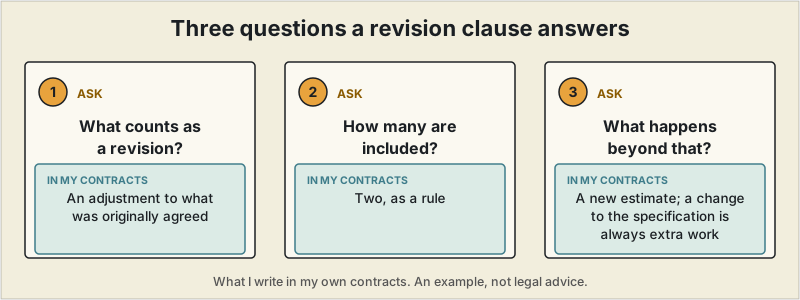
The three answers I write into a contract
- What counts as a revision? In my contracts it is an adjustment to what was originally agreed. That keeps "revision" from stretching to cover anything the client would like to change.
- How many are included? Two, as a rule. The exact number matters less than the fact that it is written down before the work starts.
- What happens beyond that? A new estimate. And if the specification itself changes, that counts as extra work and gets its own estimate, even when some of the included revisions are unused. This is the part that stops "one more revision" from quietly turning into a different project.
An example of the wording
Revisions. The fee includes up to two rounds of revisions. A revision is an adjustment to the deliverables as originally agreed. A change to the specification or scope, and any additional round of revisions, is quoted separately and begins only after you approve the estimate.
This is the kind of wording I mean, not a template to copy blindly. For a contract of significant value, have the terms reviewed by someone qualified.
Where to mention it
- In the proposal. The one-page version I use has lines for what is in and out of scope and for the number of revisions. See what I put on my one page.
- When a request arrives. Decide which bucket it falls in, inside the included revisions or a new estimate, and answer with that, as described in the extra-work steps.
What a clause can't do
A clause doesn't make a client agree to pay more. When a client told me the budget couldn't stretch to a higher rate, what worked was defining what my fee covers. I described that in Q&As for GIGS Magazine and Consultant Magazine, and the longer version is in our piece on scope creep and rate increases.
This is one freelancer's practice, not legal advice. Contract terms depend on your country and your client.
Frequently asked questions
How many revisions should a freelance contract include?
There is no standard number. Agree a figure in advance. Mine is two as a rule, and what matters is that it is stated before the work begins.
Should a change to the specification count as a revision?
In my contracts it does not. A revision adjusts what was agreed, while a change to the specification is extra work with its own estimate, even if some revisions remain.
Do I need a lawyer to write a revision clause?
A short clause like this is something many freelancers write themselves, but for a high-value contract or an unfamiliar legal setting, have the terms reviewed by someone qualified. This is general information, not legal advice.